
Information leaflets

Information leaflets

Information leaflets

Proficiency testing - how much and how often?

Content
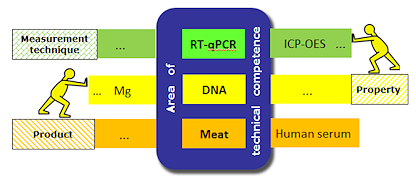
Factors affecting PT strategyAn accredited laboratory needs to define in which PT schemes it should enrol  and how often it should participate. The EURACHEM Proficiency Testing Working Group has produced an information leaflet to help laboratories select the right balance of areas of work and participation frequency. The leaflet is currently available in English and a variety of translations. Further translations will be published when available.

Availability

Translation

Please consult the PT Working Group Chair if you would like to prepare a translation in your own language.


*Publication dates are dates of website publication. English version first published on this site on 2016-01-12.

** Updated 2020-03-18 with editorial correction to footer information only

You talk, we understand – The way out of the tower of Babel

Contents

Babel 150This leaflet, prepared by the Eurachem Education and Training Working Group, explains the importance of having a common language when discussing measurements. It highlights some terms which are commonly confused or misunderstood, references the International Vocabulary of Metrology ("the VIM"), and introduces the Eurachem Guide on Terminology in Analytical Measurement.


Availability

Translations

Translation into other languages is encouraged for members of Eurachem. Other offers of translation should be directed to the Eurachem Secretariat for permission. The Eurachem policy on maintenance and development of Eurachem guidance, available on the Policies page, gives further information on translation.

1. Amended April 2017

Selecting the right proficiency testing scheme for my laboratory

Content

EURACHEM through its Proficiency Testing Working Group has produced an information leaflet to help laboratories select the most appropriate proficiency testing schemes. Several PT schemes are often available for the same area of testing, so this leaflet focuses on key questions that can help laboratories choose those PT schemes that are best suited for their needs. The leaflet is currently available in English, Italian and Spanish.

Availability

Translation

Please consult the PT Working Group Chair if you would like to prepare a translation in your own language.


*English version v2, published on this site on 2015-08-31, includes a small editorial correction to the cited reference and is otherwise identical to the previous release.

*Ukraine version 2, uploaded 2020-03-18, includes an editorial correction to footer information only.

Using repeated measurements to improve the standard uncertainty

Content

Analysts often take multiple observations, and sometimes average the result of several observations to reduce the uncertainty associated with random variation. However, it is often unclear how the standard uncertainty associated with averaged results should be calculated from an observed standard deviation. Sometimes one should divide by the square root of the number of observations; sometimes the standard deviation is used unchanged, and sometimes some alternative formula is appropriate. 

This information leaflet has been prepared by the Eurachem Measurement Uncertainty and Tracability Working Group (see here for details) to give further explanation of when the classical 'root n' formula can, and can not, be used. The leaflet amplifies principles described in the Eurachem Guide "Quantifying uncertainty in analytical measurement", which is available here.


Availability

*2015 edition

Translation

Translation into other languages is encouraged for members of Eurachem. Other offers of translation should be directed to the Eurachem Secretariat for permission. The Eurachem policy on maintenance and development of Eurachem guidance, available on the Policies page, gives further information on translation.

Amendment history

This leaflet was amended to improve clarity in April 2016. The previous English version, as issued in 2015, is available for comparison.