

Proficiency testing schemes for sampling
Content

Proficiency Testing schemes for sampling play an important role in the improvement of sampling procedures and also in the development of participants from an educational point of view, especially if workshops with the participants are organised. PT schemes for sampling can also give an appreciation of the contribution of the sampling in relation to the overall quality of the measurement, including the associated contribution to the measurement uncertainty.
This leaflet, prepared by the EEE-PT Working Group, gives some hints on the application of ISO/IEC 17043 for PT providers organising PT schemes for sampling. If there is a comparison between participants and a mechanism for performance evaluation which meets the objective of the PT scheme for sampling, then ISO/IEC 17043 is applicable.
Availability
- Download English version (Published 2020-07-29)*
- Download Czech version (Published 2021-10-07)
- Download Farsi version (Published 2022-03-01)
- Download French version (Published 2021-02-23)
- Download German version (Published 2021-02-23)
- Download Italian version (Published 2020-11-30)
- Download Swedish version (Published 2020-10-23)
- Download Turkish version (Published 2021-02-26)
- Download Ukrainian version (Published 2020-10-12)
Translation
Please consult the PT Working Group Chair if you would like to prepare a translation in your own language.
*Publication dates are dates of website publication. English version first published on this site on 2020-07-29.
 Test items are sometimes available from proficiency testing (PT) providers after the completion of a PT round. The EURACHEM
 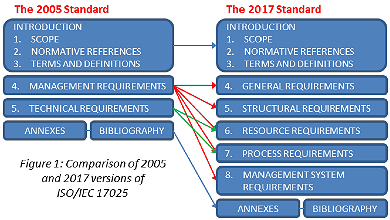 2017 saw the publication of a new version of ISO/IEC 17025 - General requirements for the competence of testing and calibration laboratories. Among other things, the new Standard has a substantially revised structure, including different management system options. There is a new emphasis on "risks and opportunities", clearer reference to sampling activities, new requirements around conformity assessment and a new emphasis on metrological traceability.
 Measurement results are only fit for purpose if the reported uncertainty is correct and has a magnitude small enough for the intended use. The target measurement uncertainty (target MU) is the maximum admissible uncertainty defined for a specific measurement goal. This information leaflet provides a short and accessible introduction to the idea of target measurement uncertainty.